November 24, ready to start on NaNoWriMo

Participant-2014-Web-Banner

Six days left in NaNoWriMo and I’m ready to get started. 50,000 words in six days? No sweat.

For those not familiar, November is National Novel Writing Month (NaNoWriMo for short). The goal is to write 50,000 words in 30 days.

Somewhere along the way I became intrigued with the idea of participating in NaNoWriMo. I wrote the first Jackson Speed novel (El Teneria) in 28 days. It came in around 60,000 words. But I did that in June of 2012, so I picked the wrong month to do it and it didn’t count. But I figured if I could do it once, I could do it again.

My initial plan for NaNoWriMowas to write the fifth Jackson Speed novel, and in October I sort of started doing research for that book. But I never really got moving on the research the way I needed to. And I’m still writing the fourth book, and I found it harder than I thought I would to switch from one book to another.

The rules of NaNoWriMo allow me to finish an already-started novel as long as I write 50,000 words in 30 days. I was already just over 50,000 words into High Tide, and I’ve always figured it would be close to 100,000 words (much longer than the other three Speed novels, but it is Gettysburg, after all).

So a couple of weeks ago I abandoned my initial plans and decided to just keep rolling on the fourth book, Jackson Speed at the High Tide.

But November has been terribly busy for me. The boys have had soccer games and tournaments on the weekends and it’s been cold and I’ve been sleepy a lot. The result is I haven’t been writing much at all.

I’ve got six days left in NaNoWriMo and I’ve written somewhere between 16,000 and 20,000 words. So I’m not really starting from scratch with just six days to go, but I am very much in a hole.

But I’ve not given up. If I can write an average of 5,000 words over the next six days, I can still win NaNoWriMo, and I think I can do it. I’ve got a couple of days off from work this week thanks to Thanksgiving, and there’re no soccer games this weekend.

So I’m deep in a hole, but I’m committed to seeing this thing through.

I’ll post an update December 1 (or sometime thereabouts) and let you know how it turned out.

In the meantime, keep watching this space. My hope is to release some short stories prior to Christmas for all you people who have Kindles on your wish lists.

Jackson Speed and the cover illustrator

I’m not yet going to post the “reveal,” but I am going to say I CAN NOT WAIT for you to see the cover illustration for the next Jackson Speed novel.

It is glorious.

When my youngest son saw the first draft of the cover, he said, “You’re going to have to write a better book to go with that cover.”

He wasn’t kidding. It really is that good.

Several weeks ago I was trying to decide what to do about the cover for the next Speed book, and I decided to try something different from the previous covers. So I started searching the internet on a number of different freelance artist sites looking for someone who I thought would be able to create a cover for me.

I spent a few days searching various sites and looking at different artists’ work when I finally ran across some pieces by Alex McArdell. I spent a couple of days looking at some of his work. Then I came back the next day and looked at his stuff again. I waffled back and forth about whether or not I even wanted to do this.

dumbledore and the inferi

Dumbledore and the Inferi by Alex McArdell

One of his pieces in particular convinced me Alex was the right guy. He did an illustration of a scene from one of the Harry Potter books – Dumbledore and the Inferi – and being familiar with the scene (I’ve read the Harry Potter books to each of my sons), I was very impressed with it.

So after looking at Dumbledore and the Inferi a couple more times, I sent an email to Alex to see what would happen.

Alex responds to emails very quickly.

That afternoon we sent a couple of emails back and forth and by the next day I think we were both pretty comfortable that we wanted to go forward.

I told Alex everything I thought I knew I wanted for the cover illustration. Alex told me all of that was a bad idea, and then I told Alex to do what he thought was best.

Telling Alex to do what he thought best was a really, really good idea on my part.

Alex took the cover design more seriously than I did with any of the previous Jackson Speed books.

After just a few emails back and forth, him asking thoughtful questions about the book and about the characters, Alex came up with some ideas that impressed me.

I explained to him that Speed was a true rascal, a coward who looks to save his own skin however he can. I also told him that in the fourth book, Speed “fights” for both the North and the South.

I wasn’t sure how he was going to accomplish it, but Alex suggested putting Jenny Rakestraw (who makes a return appearance in the fourth book) behind Speed, pulling at his Federal coat to reveal he’s wearing a Confederate uniform beneath it.

I loved the idea!

He also thought it would go along with the ironic humor of the stories to put Speed in a heroic pose – the cowardly, traitorous Jackson Speed looking all brave and daring.

Spectacular!

I told Alex I liked his ideas and to run with them, and then I waited.

Honestly, I expected to wait several weeks. I’m still months away from being ready to publish the book, and I told Alex not to be in any hurry on my account. But it was only three or four days later when Alex sent me the first draft.

I was blown away. I showed it to my wife and kids. My youngest son, Robert, said I would have to write a better book to go with the cover. Jean and I were both as impressed as we could be with what he’d done with Speed and Jenny, but we weren’t particularly thrilled with the background.

I threw out some suggestions for the background. I sent Alex some historical photos I thought might help. A day or two later – almost no time at all – Alex sent what was basically the finished piece. He still needed to do some sizing, but the image was nearly perfect.

It’s no secret that the fourth book takes place during the Battle of Gettysburg. One of the most recognizable features of that battlefield – at least from the first day – is the cupola of the Seminary building up on Seminary Ridge. When I saw how Alex managed to incorporate the Seminary and its cupola into the background, it was a wonderful surprise to me.

You’ll probably never have the opportunity to look at a high resolution copy of the illustration in Photoshop the way I did, but trust me when I say that every tiny detail in the background is there. You’ll never see the light coming from the windows of the Seminary, but having zoomed in and looked at it in almost microscopic detail, I’m just astounded at what Alex did.

For Jackson Speed fans, the good news is that having such a great cover is pushing me to write more frequently, so there’s a decent chance I’ll have the book finished sooner because of it.

If you’re an indie author looking for a cover illustration, I would urge you to consider getting in touch with Alex. I think you’ll find he offers reasonable prices, and based on my experience with him, I am certain you’ll be thrilled with the final product.

An Apologia: Sex in the Jackson Speed novels

If I were really writing explicit books, the covers might look something like this.

If I were really writing explicit books, the covers might look something like this.

Frequently when someone talks to me about a Jackson Speed novel the first topic they bring to my attention is the sex contained within.

A friend of mine started reading the first novel, commented on the “steamy scenes” and then jokingly asked if the novel was autobiographical. The question left both of us uncomfortable.

I’ve never thought the sex in the books was particularly explicit or shocking, and it’s been a surprise to me the number of people who first remark about the sex in the books.

I think it’s probably true that oftentimes a reader will walk away from a story or a book with a completely different take on it than what the writer intended, and I certainly never intended for readers to focus on the sex in the Jackson Speed Memoirs.

For me, the sex in Jackson Speed was always an integral part of the plot but not particularly memorable. Nearly every adventure that Jackson Speed encounters is prompted by some illicit dalliance with a married woman or a sexy spy or such. This is a necessary tool for me to employ, because Speed is such a coward that he would never get into any of his adventures if not thrust there by a romantic escapade or lured there by a lewd lady.

Consider if Jackson Speed were simply a coward and not an adulterer: There would be no enraged Uriah Franks (El Teneria), no trip to Baltimore (Blood Tubs), no tangential journey to Chancellorsville (Orange Turnpike), no life-long feud with Dan Sickles (Da Pont Diamond). Our hero would likely be nothing more than a blacksmith in Scull Shoals, Georgia, and what entertainment could possibly come from those memoirs?

And so the sex was only ever intended as a device to find our rascally hero embroiled in his plots.

At the same time, the novels are held out to be the memoirs of an aged Jackson Speed, and I thought it was a fun thing to have the old man greedily recalling his conquests – the pinched nipples, the heaving bosoms, the round bottoms with a pink palm print.

But I never really thought the sex was explosive or depraved or graphic.

Still, readers often bring up the sex first – and sometimes nothing else.

It would be nice, periodically, if someone wanted to discuss the well-researched history.

“I never knew that Stonewall Jackson’s glorious victory at Chancellorsville was achieved by the chance happening of Fitzhugh Lee finding a path in the woods from which he could see Hooker’s exposed flank,” a reader might say.

“Oh, yes!” I would respond. “Had it not been for Fitzhugh climbing that hill, Stonewall would have attacked along the Orange Plank Road. Likely he would have still achieved a victory, but he would have been attacking a more entrenched position and it would never have been such a rout!”

But it may be that my novels are more graphic and more depraved than I realize because my sensibilities are rougher than those of polite society. I blame it all on the desensitizing I experienced in Mr. Kirkland’s social studies class in eighth grade.

When I remember back so many years ago to the eighth grade, I remember two things. I had a terrible crush on my science teacher Ms. Hosch and I was exposed to one of the most graphic, explicit sex books that any 13-year-old could possibly endure.

It was the spring of our eighth grade year when one of the girls in the class brought a book that was – if I remember correctly – stolen from her mother. The book was the ironically titled “Wife Turned On” by Heather Brown. It was nothing more than one explicit, pornographic story after another of a woman who had sex with everyone except her husband.

We eighth graders in Mr. Kirkland’s class had removed the cover of the book and for what I remember as weeks (though it may have only been days) passed that book around the class. The sex scenes – which were many – were marked with turned-down corners and we passed the book around class so that everyone had the opportunity to quickly find and read them. My goodness. It was a lewd and graphic introduction to a topic most of us knew very little about.

So perhaps if you’ve not had the benefit of reading the marked pages of “Wife Turned On” in the back of Mr. Kirkland’s eighth grade social studies class, Jackson Speed does seem a bit raw to you. For me, however, the novels are a very tame tale of a scoundrel’s historical misadventures and are chocked full of interesting tidbits of history and fun exploits.

As it is, I must simply accept the fact that I have created a sex monster, and it is far too late to put the fiend back in his cage. And if it is the explicit sex that keeps readers coming back for more, then I’ll continue writing about the pinched nipples, slapped bottoms and insatiable spies.

But please, don’t ask me face-to-face if the stories are autobiographical. The question – if not the answer – will leave us both embarrassed.


I love to hear from Jackson Speed fans! If you don’t want to ask me any personal questions about my sex life, please feel free to send me a message here:

Go back

Your message has been sent

Warning
Warning
Warning

Warning.


Jackson Speed in the United Kingdom

For the past three months sales of the Jackson Speed books have been higher and more consistent than they ever were previously.

Jackson Speed used to sit unnoticed on virtual bookstore shelves for weeks, sometimes a couple of months, with no sales. Those were frustrating and dispiriting days as I lamented my lack of readership and obviously poor noveling abilities.

jackson speed in the united kingdomBut since May, I’ve been selling books regularly, and the real surprise is the rate at which Jackson Speed is selling to Kindle readers in the United Kingdom. I’ve noted before that the first Jackson Speed on the Orange Turnpike paperback sold in Amazon’s UK site, but through June and July better than half my Kindle sales came out of the UK.

It’s still early in August and my sales are continuing to be consistent, but so far I’ve not sold a single Kindle ebook in the United States. All of my sales this month have been out of Amazon’s UK store.

I never expected the books to sell in the United Kingdom the way they are. The protagonist works his way in and out of America’s 19th Century conflicts (mostly with herself), and as a result when I first started writing, the audience I had in mind was strictly an American audience.

I am left to conclude that the reason the Brits are buying the Jackson Speed books is because of the obvious influences George MacDonald Fraser’s Harry Flashman had on Robert Peecher’s Jackson Speed. As I’ve noted before, I am a massive fan of the Flashman novels, and Fraser’s creation was the inspiration for Speed.

I entered the latest Jackson Speed novel in the Reader’s Favorite book contest, and disappointingly (but not surprisingly) I didn’t even make it to the finalist stage. As part of the contest, Reader’s Favorite reviews the book and posts the review on their website.

Though the book received four stars out of five, the reviewer clearly is not a fan of Jackson Speed.

She called him a sociopath!

I feel terrible for poor Jackson Speed. I’ve heard him described as everything from a rascal (my personal favorite, thanks Mandy Stephens!) to despicable, and now he’s “sociopathic.”

From the review: “Jackson Speed has so few redeeming qualities that it didn’t quite leave me laughing.”

Well, as Ol’ Speedy might point out, there are plenty of men with no lack of redeeming qualities who found their way into an early grave while he’s able to enjoy the peace of his sunset years.

So, perhaps the answer to the mystery as to why my books are selling so well in the United Kingdom is simply this: The Brits simply love a sociopath.

Either way, every sale of one of my books is humbling and gratifying. I cannot express how much it means to me. I’m still a long way from making any best seller lists, but when I started writing these novels I wasn’t sure if anyone, anywhere would find them interesting or entertaining. The fact that people do seem to be entertained by them (as demonstrated by the fact that it’s not just El Teneria selling, but all three of the Speed novels) is just overwhelming. It really is.

As I’ve said before, I love to hear from Jackson Speed readers. If you’d like to be added to my list to receive updates about the next Speed book, you can send me a message through the form below. And if you’re one of the Speed readers in the United Kingdom and you’re thinking of sending me a message, I’d love to know how you found the novels.

Also, you’ll want to get added to my email list because when I told my wife that my sales in the United Kingdom were doing very well, she immediately started planning a UK book signing tour. Details on that tour will be available as soon as we can afford it.

Based on my current rate of sales and the 8-day packages she has been able to put together, it appears that the Robert Peecher book signing tour in the United Kingdom will be in about 63 years!

I can’t wait!


Go back

Your message has been sent

Warning
Warning
Warning

Warning.

Celebrating a milestone!

ONE THOUSAND BOOKS!

It’s been a pretty good month for Jackson Speed and his editor (me).

Last month I published the third book in the Jackson Speed series and (for the first time) I spent some time creating a spread sheet with all of my Amazon.com sales (to include paperbacks and Kindle downloads, paid and free).

As May came to a close and June started, I realized that I was just eight books away from hitting my first big milestone. I had already distributed 992 books (that’s a combination of all four of my books) through Amazon.

I posted it on Facebook and a few of my friends were kind enough to drop $3 (or in a couple of cases, $12 plus shipping) to push me over the edge.

I’ve now distributed 1,000 books through Amazon.

These people are not celebrating the World Cup being in Brazil, they are celebrating 1000 copies of Jackson Speed novels going out through Amazon.

These people are not celebrating the World Cup being in Brazil, they are celebrating 1000 copies of Jackson Speed novels going out through Amazon.

I know what you’re thinking: “Wow! A thousand books! This dude must be a millionaire!”

That’s what I was thinking, too!

But I’ve run the math with a calculator (twice) and I’m not a millionaire. If 1000 book sales were going to make me a millionaire, I’d have to be selling my books for $1000 a piece.

Besides, most of those 1000 books that I’ve distributed through Amazon were on free Kindle days where people were able to download the book for free. So I haven’t sold 1000 books through Amazon, but I’ve distributed 1000 books through Amazon.

Anyway … it’s a milestone all the same.

The hope is that the people who download the book for free will enjoy it and maybe come back for more. The truth is, most of the people who download the book for free haven’t read it and never will. When people see free books that interest them, they’ll frequently download the book but never come back to it (I’ve done it myself).

However … I have heard from a handful of readers who did download a book for free and enjoyed it, and that’s the neatest thing to me – being able to connect with people who like my books and are literally all over the world.

At some point, I gave up on marketing my books. I decided the more important thing for me was to write more. Book marketing becomes a full time job if you let it, and I have a full time job. I had to either market my one book or write more books. So I decided to write.

The extent of my marketing scheme now is that I post on Facebook sometimes, tweet links to my blog or books on Twitter once in a while, and I update my blog periodically.

The fact that I’ve had 1000 people get copies of my books with little marketing from me is a true blessing.

I’m still writing and still not marketing (though at some point I do plan to really start pushing the marketing), so 2000 books through Amazon may still be a year or two away. But that’s okay. I’m loving writing, I’m enjoying connecting with readers, and I’m having a great time making spread sheets that show that in one month there were 46 people who downloaded El Teneria for free and in the following two months 14 people bought Blood Tubs, the sequel to El Teneria.

Anyway … if you can count yourself among the 1,000 people who have gotten my book through Amazon, I honestly, truly, sincerely am grateful to you.

And if you’re one of the people who has sent me an email or a message on Facebook or a comment through my blog or if you’ve come to a book signing or posted a reader review on Amazon or in any way expressed to me that you enjoyed my book – again, thank you so much. I don’t have the words to tell you how much it means to me.

When you write and publish books, you take a huge part of yourself and put it on display for other people to see. When you read a book, you get a glimpse into the mind of the author – his thoughts and imagination are on display.

It’s a terrifying and embarrassing thing to expose yourself like that.

But … if you’re among those 1000, I appreciate what you’ve done to help make it a little less terrifying and embarrassing. I guess the real joy isn’t whether or not I’m making millions of dollars with my writing (although I am considering pricing Jackson Speed at the High Tide at $1000 when it comes out), but the real joy is having people respond favorably to the things I’ve written. Thank you so much for making these last couple of years writing about Jackson Speed a real joy!

* I should note that I’ve sold or given away many, many paperbacks, too (I don’t have good numbers on that, but somewhere approaching or maybe just over 200). So if you’re a Jackson Speed fan but you’ve never bought a novel through Amazon, I’m also grateful to you!

Jackson Speed Origins

Fairly often I get some variation of the question: Where did Jackson Speed come from?

The “Jackson Speed Origins” is a story I enjoy telling.

Ol’ Speedy was born in May of 2012.

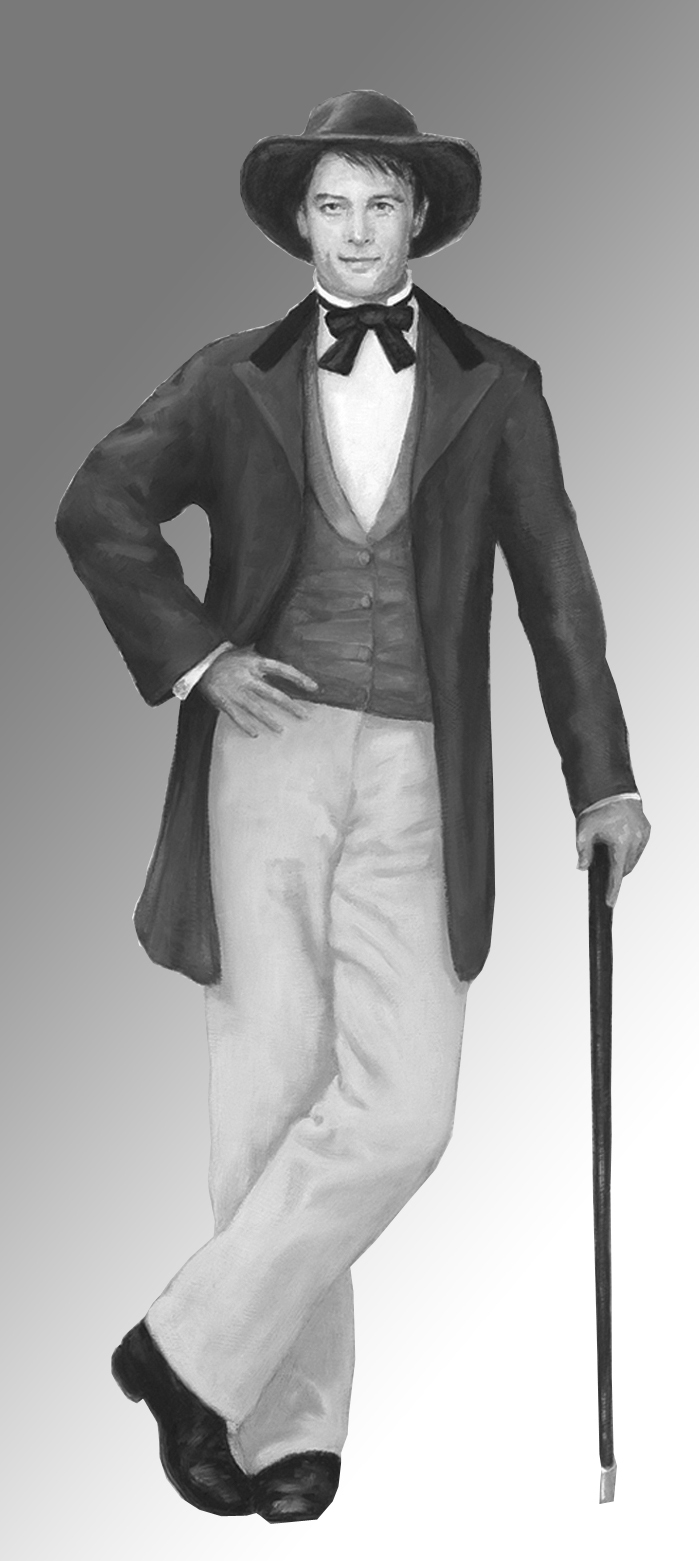
Seriously ... this guy? A rogue? A rascal? A scoundrel? Make of him what you will, but the ladies all found him loveable (so he says).

Seriously … this guy? A rogue? A rascal? A scoundrel? Make of him what you will, but the ladies all found him loveable (so he says).

At the time, I was reading two books. I had recently decided to re-read the Flashman series (it was going to be the third or fourth time I’d read most of the books) and was just starting on the first book in that series. I was also about 100 pages into Shelby Foote’s The Civil War: A Narrative.

This particular morning I was waiting for my wife to finish getting ready for work (we work together so we typically commute together) and I was reading Foote’s book. In it, Lincoln had just been elected president and was on his train tour from Springfield to Washington D.C. for his first inauguration.

Foote wrote a couple of paragraphs on the Baltimore Plot to kill Lincoln, foiled by Pinkerton and a what Foote described as “a female detective.”

And bam! just like that Jackson Speed had arrived to take his place in history.

It was, perhaps, the only true epiphany I’ve ever had in my life.

I saw the whole of Jackson Speed’s life in front of me: The Mexican-American War, the California Gold Rush, the American Civil War, the Congressional Medal of Honor at Gettysburg, Texas Rangers and Indians and outlaws and cattle wars in the Old West, the Hatfields and McCoys, Teddy Roosevelt looking on Ol’ Speed as a hero …

I even saw the mill at Scull Shoals burning.

I suppose I could have fashioned Speed after Horatio Hornblower or one of these other countless heroes who not only wrestle with the bad guys but also battle temptations that seek to turn them from their own ethical and moral codes. Though I like the Hornblower novels, and Robert Parker’s Spenser and Bernard Cornwell’s Sharpe (and Starbuck, if we’re talking about characters in the Civil War), those are not the characters who really spark my interest.

Han Solo (not Luke Skywalker) was my first favorite fictional character. I was a fan of the womanizing James Bond. Byron’s Don Juan, Fielding’s Tom Jones (at least in the beginning), and, the greatest of them all, George MacDonald Fraser’s Harry Flashman: – These are the characters who have always seemed like the most fun to me, and from them came Jackson Speed.

From the start, Jackson Speed was always going to be a scoundrel. I mean, the very first scene in El Teneria – the burning of the mill at Scull Shoals – and the entire premise of his journey to war in Mexico necessitate his two primary characteristics.

Speed’s only motivations in life are his own survival and his insatiable lust. It is much easier to write about a character who has no moral code to live up to.

I also like the conceit of these novels being Speed’s discovered memoirs – the reminiscences of a man whose years are running low. Because the series is held out to be Speed’s memoirs, written late in a long life, it gives him an omniscience that I think is necessary for the character. I also like that he is attempting to correct the record (complaining that Fitz Hugh Lee failed to mention him in Lee’s own recollections of Chancellorsville).

I have an image of Ol’ Speedy – the old man writing his memoirs – sitting in his study and thinking on the near escapes, the maniacs who constantly tried to get him “in at the death,” as he likes to say, and the women who frequently led him to danger. Especially the women. I love the notion of the randy old bastard remembering the women who loved him by the color of their nipples.

I wonder, too, as I write the novels, if Speed is being completely honest with us. Was he really so much a rascal as he paints himself to be? Was he really as awful? If you notice, he’s never bedded a woman who didn’t fall ass over head in love with him, and I have to wonder at that, too. If Jenny Rakestraw or Kate Cherry or Marcilina de la Garza had left their own memoirs for us to read, would they confess to being as fond of Speed as he claims they were?

I wanted Speed to walk a narrow line of loveable rogue – not the rogue part, but whether or not he was loveable. There are scenes when I’m writing that I think to myself, “Careful … you don’t want Speed to redeem himself here.” And that’s when I try to find something really nasty for him to do.

Regardless, though, I’ve really come to like the old guy.

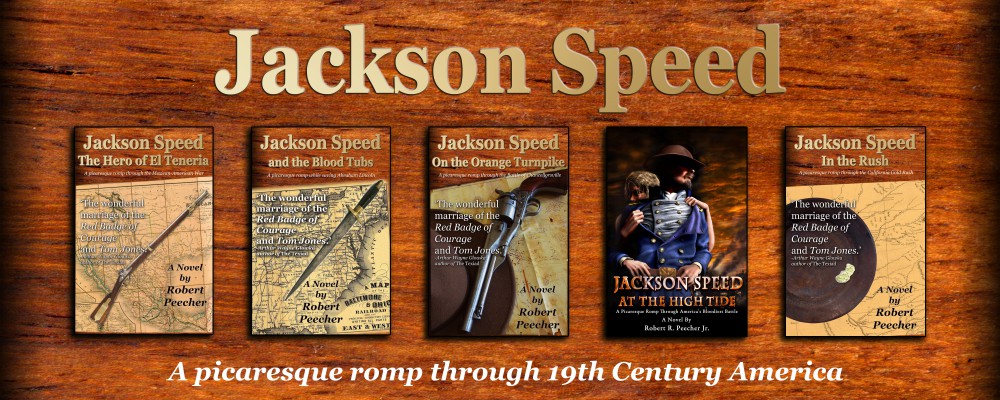
A reader review posted at Amazon.com for El Teneria says, “The history is true and the fiction is fun.”

That’s what I was going for.

So if you’re interested in history and you think the bad guys have more fun, I hope you’ll give Jackson Speed a read. And if you do, please send me a note to let me know what you think!
 

Go back

Your message has been sent

Warning
Warning
Warning
Warning

Warning.

Sam Grant in a dress

As I conduct research for my Jackson Speed novels, I am always learning bizarre little tidbits from history, some of which I try to incorporate and others I just enjoy for what they are.

For instance, were you aware that U.S. Grant wore a dress during the Mexican-American War?

The story is related by James Longstreet in his memoirs From Manassas to Appomattox.

Sam Grant as Shakespeare's Desdemona in the Moor of Venice.

Sam Grant as Shakespeare’s Desdemona in the Moor of Venice.

Longstreet and U.S. Grant were together at West Point. Grant graduated a year behind Longstreet. As young lieutenants fresh from the military academy, both were appointed to the Jefferson Barracks in Missouri. A lifelong friendship developed.

Longstreet was with Grant the first time he met Julia Dent (who became Grant’s wife). After the war, when Grant was president, he appointed Longstreet to a variety of government jobs. The two were close friends, despite having fought on separate sides during the War of Northern Aggression.

When the war drums started to beat in the new Republic of Texas and the United States seemed intent on answering their call, Grant and Longstreet both were ordered from the Jefferson Barracks to serve in the Mexican-American War.

Grant, particularly, distinguished himself in that war and was brevetted for valor.

But before the shooting started, there was much down time. In Missouri the young officers were accustomed to balls and hops and gay society. Down on the plains of Texas, there was little to relieve the boredom of waiting for the shooting to start, so the officers formed a small theater where they put on several performances.

They raised enough money among themselves that they were able to build a theater. Longstreet says that the performances were popular and that “the house was filled every night.”

Soon the young officers had money enough to buy costumes.

When they decided to perform The Moor of Venice, Grant was selected to play the part of the daughter of Brabantio.

So there he is – the future president of the United States, the man to whom Lincoln would turn to finally conquer Robert E. Lee and the Army of Northern Virginia – wearing a dress and playing the part of Desdemona.

But Sam Grant wasn’t long in a dress.

Lieutenant Theodore Porter played the part of Othello, and apparently Grant served as too poor of a love interest to inspire Porter’s acting abilities. Porter complained that male heroines “could not support the character nor give sentiment to the hero,” Longstreet says.

So the officers sent to New Orleans and secured an actress, Mrs. Hart, to come and “give sentiment” to Porter.

Porter was killed soon after by Mexican banditti.

I love these scenes from history that have been left out of text books and largely forgotten. These are the events that tend to humanize the people whose names you had to memorize in high school history classes.

And for me, I think it gives me a better ability to show my readers Sam Grant through Jackson Speed’s memory if I always keep in the back of my mind that Grant not only wore a dress but made such a poor woman that he failed to inspire Ted Porter.