Email list

After my book signing at Reinhardt University I realized I should probably have gotten  email addresses for the folks who attended the talk/reading/signing so that I can add them to a list to send out when there’s news about my books or appearances I’m making or something like that.

So, I’ve started a new email account just to use for promotional type stuff with the Jackson Speed novels. If you’d like to get added to this list so that you receive an email when there is an event scheduled or a new book release (“Jackson Speed and the Blood Tubs” will be out soon!), then shoot me an email at robertpeecherauthor@gmail.com.

I’ll add you to my list and periodically send you an email. I will not sell, trade or in any way give out your contact information.

Q&A with the author

I’ve started a Q&A section at Goodreads.com for the Jackson Speed books, and to kick it off a little bit I decided to go ahead and ask myself the first question and answer it. It is the question I most often get from people who have read the book:

“Was the Battle of the Boat real?”
The answer is an unbelievable YES!

In researching Jackson Speed, I used (among many other sources) newspaper articles from a couple of Georgia newspapers. As I was reading the articles, I read one that referred to a “despicable incident” that occurred between two companies from Georgia. I knew immediately, whatever companies were involved and whatever happened, I was somehow going to have to get Ol’ Speedy involved in that.

I did a fair amount of research beyond the newspaper articles, and the sources were sometimes wildly divergent in their details. Some of the newspaper articles were so wrong about what took place (one article, for instance, had Col. H.R. Jackson shooting his own men on the deck of the boat, when in fact he was miles away with Gen. Taylor), and often those errors of fact were never corrected.

None of the sources I could find was what I would consider authoritative, although some had very specific details that were clearly accurate. So I took what made the most sense out of all of my sources and created Jackson Speed’s version of the Battle of the Boat. I believe it is accurate, or accurate enough. It does seem that the fight began over anti-Irish insults from the Kennesaw boys against the Jasper Greens; I believe the fight started down on the beach and was taken up later in the day on the deck of the boat. It seems to me from all of the sources that it is most likely that the fight was under control by the time the Illinois Col. Baker rushed the boat.

The Battle of the Boat was one of the great surprises to me as I researched the book … what a wonderful episode of history (mostly forgotten) to be able to add into my novel!

Free giveaway

All the conventional wisdom in the self-publishing market tells you that if you want people to read your book you’ve got to give it to them for free. So this week, I’m giving away “Jackson Speed: The Hero of El Teneria” for three days. September 25, 26 and 27 (Tuesday – Thursday) the book will be free to Kindle users or those who use a Kindle app on their smart phone or tablet or whatever.

I’m actually familiar with the idea of giving stuff away for free and getting people to read it. I mail out 12,500 copies of The Oconee Leader (my newspaper) to people each week and it arrives in their mailboxes free of charge every Thursday. With the newspaper, we sell advertising and that’s what allows me to pay my employees and feed my children. Giving the paper away for free (I thought) was pretty much a stroke of genius on my part, and ad sales have been pretty decent and it seems like the idea works because people are reading the paper.

But there are no ads on the pages of my novel, so I give it away for free and have to hope that people will read it, enjoy the book, tell their friends about it and then their friends will buy the book. Obviously, I didn’t write “Jackson Speed: The Hero of El Teneria” with the expectation that I’d make a lot of money. I’d like to make back what I put into it, and anything else I make off of it will go into my Thistle fund (the savings for one day traveling to Scotland to see Partick Thistle play … doesn’t everyone have a Thistle fund?). More importantly, I want people to read the book, and so I don’t mind giving it away in the hopes that people who read it will enjoy it and tell others to read it.

But at heart I’ve always been an entrepreneur, and I’m giving some serious thought to how I can rework some of my ideas and turn this whole novel writing thing into serious cash. What would happen if I started selling “product placement” ads in the Jackson Speed novels? They do it in the movies and no one questions the integrity of, oh – I don’t know – the Transformers movies.

So, when you start reading “Jackson Speed and the Blood Tubs,” (set in the first months of 1861) don’t be surprised if Speed is drinking a Budweiser while hanging out on the platform of the Calvert Street Depot and whistling “Dixie.” Or if Eliza orders a Coca-Cola in New York City and is furious to learn they only serve Pepsi (obviously, the product placement dollars are coming from Coke!) or if, when Speedy goes to Baltimore, he stays in a Holiday Inn Express.

And if you read it and decide to question the historical accuracy of my novels or the integrity of the author, you’ll have to save your complaints, I’ll be at Firhill enjoying a pie and Bovril and watching the Mighty Jags!

Anyway, my point is, go check out “Jackson Speed: The Hero of El Teneria” … free on Kindle Tuesday, Wednesday and Thursday of this week!

Download the book … it costs you nothing (for three days).

Back cover of Jackson Speed and the Blood Tubs

While writing about the night of the red ballot last night, I topped 50,000 words on the next Jackson Speed novel. I’m shooting for 80,000 total, and I feel pretty confident that you Jackson Speed fans will be able to put “Jackson Speed and the Blood Tubs” on your Christmas wishlist.

So this morning I’m kicking around some thoughts for the text on the back cover (because it’s all about the marketing, don’t ye know) and I’ve come up with the paragraphs below.

Here’s what I’ve got for the back cover:

Allan Pinkerton called it “the Night of the Red Ballot.” It was the night that president-elect Abraham Lincoln’s would-be assassin was selected among the members of the Blood Tubs. Seated at the head of the room was a sinister Corsican with round-rimmed glasses and a thin, almost weak frame. Ferrandini had sworn that the Black Republican would never live see the White House and took a vow that he would sacrifice his own life so long as it meant Lincoln’s death.

Among those gathered in the room was Jackson Speed, confident that it did not matter whether he pulled a white ballot or a red ballot, he was in no danger. Ferrandini’s plot had foiled Pinkerton’s plans and Ol’ Jackie Speed had nothing to fear.

Or did he?

America’s reluctant adventurer, inadvertent hero and all-around scoundrel is back, and he’s on a mission. Sent by Allan Pinkerton to save Abraham Lincoln and the Union, Speedy can’t keep his hands off one of Pinkerton’s detectives (and any other belles of Baltimore who cross his path) long enough to stay focused on the plotting of the Blood Tubs.

Can Lincoln survive long enough to make it to the inauguration? With Pinkerton Detective Jackson Speed on the case, it seems unlikely.

All my characters are dead

One peculiarity about writing historical fiction is that while your characters live in your imagination and on your page they are, in fact, dead. And when you write historical fiction that incorporates actual people as characters of your book, their lives go on beyond the pages of your book in a way that other characters do not.

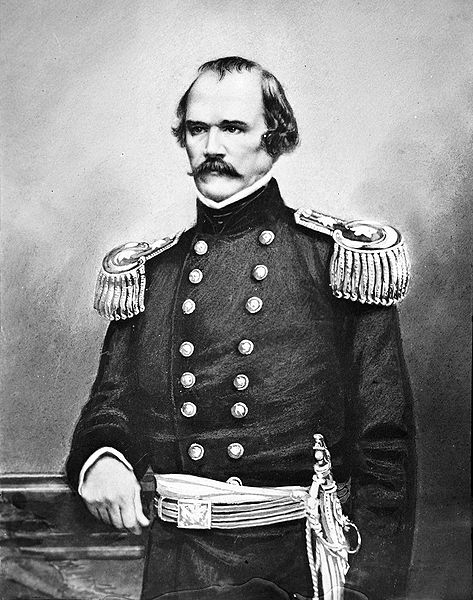
In the first book of the Jackson Speed Memoirs, both Texas Ranger Ben McCulloch and A. S. Johnston appear as minor characters (Johnston much more minor than McCulloch).

Both men went on to serve as generals for the Confederacy in the American Civil War.

A.S. Johnston

Part of the research I am doing for the Jackson Speed memoirs is reading about that Civil War. I am slowly picking my way through the first volume of Shelby Foote’s “The Civil War: A Narrative.”

(To give you an idea of what I mean by slowly: Since I started reading Foote’s “The Civil War” I have written a book and a half and read three other books. For someone interested in the Civil War, it is a great and fascinating and massive retrospective of the war.)

In just a matter of pages – from the Battle of Pea Ridge to Shiloh – I read about the deaths of first McCulloch and then Johnston.

Though I’ve studied the Civil War for decades now, I could not have predicted either of their deaths at these places, so they came as a surprise to me. I’ve never read much about Shiloh, and though I knew Johnston was killed early in the war I did not know where, and prior to my research for “Jackson Speed: The Hero of El Teneria,” I’d never read anything about McCulloch.

Because these men appeared as characters in my novel, I felt like I knew them a little bit. I’d studied enough about both of them that I felt confident in writing about them. And so I was a little sad when I read of their passing (150 years ago) in the same way that you’d be a little sad when reading an obituary of an acquaintance you’d known a little and liked pretty well.

But I was also a little gratified when I read of their deaths, because I believe they died in exactly the same sort of way that the characters from my book would have died. Both of them were leading their men into battle: McCulloch feverishly at the front of a charge and Johnston (atop his horse) calmly and kindly, and also at the front.

When Jackson Speed meets these men from history, I try very hard to be as true to their memories as I can be. They are all seen through the filter of my character, who has his own notions about courage and leadership which may not correspond with what McCulloch or Johnston thought of courage or leadership, but I want my readers to be able to walk away from the book with the impression that they saw the real man.

Having read of the deaths of McCulloch and Johnston, I’ve decided from now on when I write about people who actually lived and incorporate them as characters in my novels, I will be sure – before I write about them, instead of after – to research their deaths.

As in the case of McCulloch and Johnston, I believe in some cases when you read of a person’s death you get a further glimpse into their true character. In both cases, I got it right by being lucky.

But also, I don’t want to get caught again reading a book and find out 150 years later that an acquaintance has died.
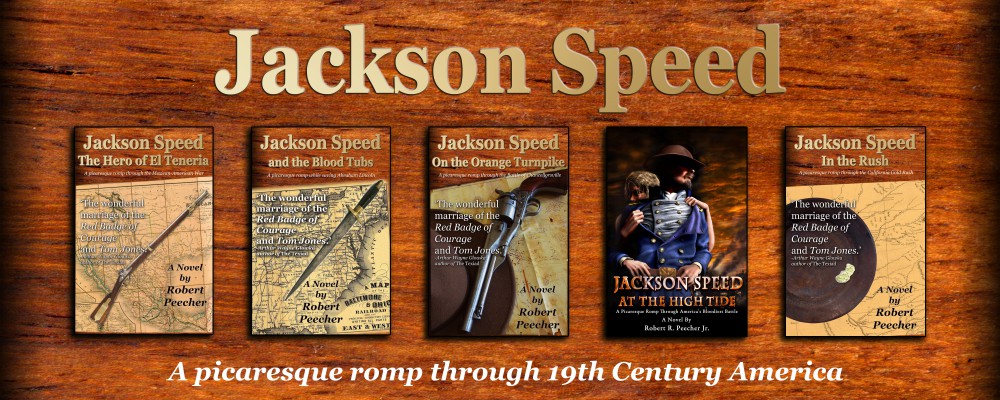
The Hero of El Teneria

According to Merriam Webster, the first known use of the word “cad” was in 1833, three years after our reluctant hero Jackson Speed was born. Can this be a coincidence? Of course not, when Ol’ Jackie Speed was first toddling around, someone somewhere clearly realized they were going to need a word to describe him.

So here’s Jackson Speed, America’s greatest cad.

In the first volume of the recently published Jackson Speed Memoirs (Jackson Speed: The Hero of El Teneria) the reader is introduced not to the Jackson Speed of the history books but to the true Jackson Speed – the coward, adulterer and cad that no one knew he truly was.

Volume I of the memoirs takes us briefly through Speed’s childhood and the events that forced him to leave his boyhood home of Scull Shoals. We meet his lovely red-headed wife and discover the circumstances that brought them to marriage and we see Speed get his first taste of battle in the Mexican-American War.

“Jackson Speed: The Hero of El Teneria” – it’s a picaresque novel, don’t ye know.

It’s available at Amazon.com. Get your copy today!