Beach book

What book are you taking to the beach this summer?

Dan Brown’s new book is the current top seller at Amazon.com, and The Great Gatsby is in the Top 10, presumably because of the recent release of a movie based on the book.

I loved Gatsby when I was in high school. The summer I was 15-years-old I went on a cruise through the Baltic Sea, and I took Gatsby and Catcher in the Rye with me. It would be difficult to say which of those books I liked better that summer. The Gatsby cover was torn and cracked and bent by the time I went to college, but the cover for Catcher in the Rye was completely gone when I graduated high school.

I will warn you, if you are 15 years old and you want to spend the summer with your peers having a lot of fun, don’t go on a cruise through the Baltic Sea. It was an amazing experience, and I wouldn’t trade it for anything, but the average age of the passengers was probably around 62. There weren’t a lot of other teenagers on that cruise for me to hang out with.

I got to be friendly with one of the performers, Keith Cox, and spent a fair amount of time hanging out with him, but when he was working I mostly drank Cokes and read books in one of the lounges aboard the ship. I liked that lounge in particular because the woman working behind the bar looked exactly like Samantha Fox. So I read the Great Gatsby and flirted with a Samantha Fox look-a-like in an otherwise empty lounge on a ship full of retirees.

Gatsby and Holden Caufield seemed like the perfect company aboard that ship.

But they are not the sort of guys you’d want to take on vacation to the beach, are they?

Beach reading, it seems to me, should be light and fun. Why ruin a good time with a dark and brooding book?

So I’m curious, what book are you taking to the beach with you this summer? Post a comment and let me know.

Harry Flashman and Jackson Speed

Most everything I read for pleasure is historical non-fiction. It really has to be the right sort of book for me to read a novel. I suppose that’s not the right thing for a novelist to say, but it is what it is. The novels I enjoy are those by Bernard Cornwell and C.S. Forester and similar novels.

But my favorite novels, by far, are those by George MacDonald Fraser. I am a massive fan of the Flashman novels. When Fraser died it was like a punch to the gut to realize there would not be anymore Flashman books.

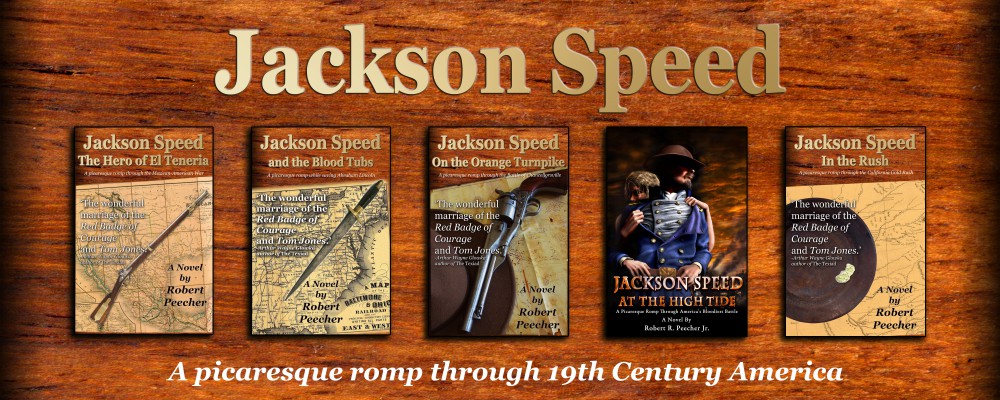
In some respects, Jackson Speed owes a great deal to Harry Flashman. Like Flashman, I set my character up as a coward whose actions are often misinterpreted as heroic. Like Flashman, Speedy is a great philanderer. These are common enough anti-hero themes, and I’ve enjoyed numerous other books in the same vein, but it was Flashman I had in mind when I started writing about Speed.

I also employed the device of holding my novels out as the memoirs of Jackson Speed in the same way that Fraser’s novels were the “discovered papers” of Harry Flashman. Again, Fraser didn’t invent the technique – it goes back to Defoe’s Moll Flanders and was a common narrative technique in 18th Century English novels, but it was Flashman I had in mind when I started writing about Speed.

I’ve often wondered if Flashman wasn’t a little better than he made himself out to be in his papers, but I think at the end of the day you must take Flashman at his word. There are a few cues, I think, that show that Flashman’s papers accurately portray him as a complete scoundrel.

When I started writing about Speed, I wanted to leave the question a little more open to critical examination than that. Fraser, I think, employed the “discovered papers” technique as a way for the supposed hero to confess how truly awful he was. I’m consciously allowing that maybe Jackson Speed wasn’t as big a coward as he remembered himself being. It’s possible that the women didn’t love him quite as much as the old man writing the memoirs thought.

Part of the character of Jackson Speed has to be the man writing the memoirs, not just the man the memoirs are about.

Truthfully, I’m undecided if the old man writing the memoirs is accurate in his depiction of himself and the events of his life or if it is possible that the old man’s recollections are colored by cynicism. I suppose he might have even been more of a coward than he lets on, for that matter. But there are moments when I’m writing and I’m carefully trying to construct an opportunity for a reader to say, “No, Jackson Speed was never that big a scoundrel.”

The Jackson Speed books are intended to be fun, light reading. There’s a good bit of action, and the books are bursting with historical information. I threw in some lewd sex scenes to appeal to the college kids (because when I was in college that was all we were interested in). I hope readers find the books amusing because the Speed books are intended to be more than a little comical.

But they are not the Flashman novels and even on my most optimistic of days I never once considered that they were comparable. Flashman is unique and superb, and I would be appalled if I thought people were judging my work alongside George MacDonald Fraser’s. Fraser was a genius. I’m just a guy who writes books in his spare time.

I doubt seriously if a hardcore Fraser fan would find my books very appealing. I suspect, instead, that the things that make Jackson Speed not Harry Flashman would be enough to disappoint them. More to the point, the things that make Robert Peecher not George MacDonald Fraser would certainly disappoint them.

That said, if you like the sort of humor you find in the Speed novels and you enjoy your historical fiction with a bit of womanizing, some cowardice and some humor and you’re looking for a good novel to entertain you while you wait for the next Speed book to come out, let me strongly urge you to give Flashman a try. You’ll thank me for it.

If you have not read about either Jackson Speed or Harry Flashman, click this link, buy this book, and read it first so you won’t be tempted to compare my books to Fraser’s.

If you have read the Jackson Speed books and your are going nuts waiting to find out what happens to him on the Orange Turnpike, then click this link and buy this book and read it, but remember, even though George MacDonald Fraser is a better writer than I am, you’re still a Jackson Speed fan and you still want to find out what happens to him on the Orange Turnpike!

If you’re not interested in history and you don’t much care for novels but you like funny columns about raising boys, click on this link and buy this book.

Q&A with author Arthur Glowka

One of my favorite people in the world is Arthur Glowka. He was my Arthurian Lit and History of the English Language professor in college. I interned with him for a quarter putting together a Georgia College publication, and especially when I worked at the Macon Telegraph I interviewed him a number of times for stories.

Over the past year Dr. Glowka has published three books, all available through Amazon.com.

Recently I asked him some questions and he answered them:

Q. Let’s talk about “The Texiad.” What prompted you to want to write an epic poem about the Texas Revolution?

I had two motives for working on such an ambitious project. One, I have been wanting to write an epic poem for some forty years, and I have kept up the practice of writing metrical poetry and doing weird things like talking to myself in blank verse while I drive. My previous book was a verse translation of a 12th-century Old French chronicle poem (“The French Book of Brutus: A Verse Translation of Wace’s ‘Roman de Brut’”), and in the ten years I worked on getting that book published, I imagined that I was in training for my next work, an epic poem.

Two, I grew up in San Antonio, Texas, and have been fascinated with the Alamo and the Texas Revolution since early childhood. About 8 years ago, I got very homesick, took a trip to San Antonio, revisited the Alamo, bought a pile of books on the revolution, and then began writing one Sunday morning as I sat in my car, waiting for my children to get out of Sunday school.

glowkaQ. I know your research was extensive. What was the most interesting thing you learned in doing your research that you did not already know?

I learned that the story about William Barrett Travis and the line drawn in the sand was probably fiction and not fact. I also learned that the Mexican gun powder was so bad that a man could get hit in the forehead with a musket ball and live—since it might just bounce off. The main injury in that case was the jokes made by comrades about the victim’s hard headedness.

Q. You mention in your acknowledgements that there are areas where you go astray of the historical record and I know you go into some disputed history with Zuber’s account of Louie Rose. And epics, historically, tend to exaggerate anyway. So in writing an epic poem about the Texas Revolution, how important was it to you that the history be accurate and how willing were you to stray from that?

I started off trying to be historically accurate, but the story did not take form or get much traction until I hit on the idea of having William P. Zuber as the narrator. That decision freed me to tell the story from the perspective of the man responsible for the account of Travis’s line in the sand. I could then elaborate on my own about Santa Anna’s love affair, throw in a talking, prophetic devil, and invent the details of a conversation between Santa Anna and Andrew Jackson. Epic creates and enshrines legendary history. The legends become myths that explain who we are and what we value in a form more exciting than that in an analytical historical account.

Q. I absolutely love that the narration in “The Texiad” comes from William Zuber. Honestly, I didn’t know all that much about him prior to reading “The Texiad,” but now I’m completely enthralled with the image of the last surviving veteran of the Texas Revolution wandering around lecturing kids about his war. Tell me about the idea to use Zuber in such a fashion – where did it come from?

Zuber’s account of the last days of the Alamo as told to his mother by family friend Louis Rose was controversial in his lifetime. In fact, he spent a great deal of energy defending the veracity of his account in print. When he was a very old man, he got a job as a tour guide at the Texas state capitol, and I could not imagine that this man with his passion for the Texas Revolution would not tell Rose’s story and others like it to visitors whenever he could. With him as a vehicle, I was not limited to documentary evidence, and I became free to invent details and scenes that inquiring minds simply want to know about.

Q. Writing in verse, to me, is about the most painful thing that I can imagine. I can’t imagine how hard it is to write an epic poem. Will you write another epic poem, and if so what topic?

I have practiced writing rhymed metrical verse for almost 50 years, but the use of the rhyme royal stanza slowed me down considerably. Sometimes I would spend up to an hour trying to place a rhyme word in a sentence without disturbing either the sense or the meter of what I was writing. If I write another epic, I will use blank verse. I have toyed with the idea of an epic about Jesus, King David, or Revelation.

Q. In addition to “The Texiad,” you’ve also written “The Seduction of Sir Gawain,” and you’ll soon have a Lancelot book published. Having taken your Arthurian Legend course and your History of the English Language course at Georgia College, in my mind I always associated you more with Le Morte d’Arthur than I did Le Morte de Travis. Is Arthurian legend more comfortable ground for you?

I am very much at home in Arthurian romance. I find the stories patently humorous, even when they are not intended to be humorous. The fall of Arthur’s kingdom, of course, is not humorous at all, but the individual romances strung together by Malory are very charming and leave much unsaid. I see great potential in developing the unsaid parts of the romances.

Q. Why prose for your Gawain book and not epic poem? Too many Arthurian epic poems already, or were you just simply unwilling to go toe-to-toe with Edmund Spenser for sales?

“The Seduction of Sir Gawain” is a retelling of “Sir Gawain and the Green Knight,” an anonymous romance of the late 14th century. This romance is told in alliterative verse in a very difficult dialect. The verse translations of the poem I have read with students are not much easier to read than the original. So I thought that I would retell the story within the conventions of modern prose narrative and allow myself room to add to the story and change details to suit my own ends. So the story ends very differently: Sir Gawain wins a bride he doesn’t want (a detail from another story about Sir Gawain), and we get to hear his hilarious confession — after he gives into a temptation he resists in the original. The confession is my favorite part. I tried to impart some of the flavor of a Harlequin Blaze romance I read in preparation for writing the book.

Q. Which do you prefer to write, prose or verse?

I like both, but after spending some 18 years writing long works in verse, I thought it would be fun and liberating to try prose. I have at least two other prose works in planning. But I am still obsessed with the idea of writing some kind of Biblical epic.

Q. I don’t know if you know this, but when you published the Texiad that was sort of my inspiration to self publish. I remember you posted on Facebook that you felt like Caxton (William Caxton, who introduced the printing press to England). I read all the time about big publishing houses having trouble. I read recently that there are something like 700,000 self-published authors now thanks to Smashwords and CreateSpace and similar publishing platforms. Do you think we’re in the beginning stages of something that will have as big an impact on the world as Caxton’s printing press did?

For well over a hundred years after Caxton opened up shop in England, poets still thought printing was beneath them and passed their poems around in manuscript. Friends published them, often without permission. Manuscript copying also continued for a long time, and early books were attempts to make printed text look like handwritten text. The contemporary publishing house with an editorial staff devoted to choosing and developing texts that it thinks will bring a financial return on the massive expenses of printing and distributing paper books will continue for a while, but I imagine that the traditional publishing house and the mass market bookstore may soon go the way of the medieval scriptorium and the late-20th-century video store.

This week Dr. Glowka published his second Arthurian tale – The Humiliation of Sir Lancelot. It is currently (May 17) available for free to download on Kindle, as is The Texiad.

Dave Ramsey and my teenager

Recently my oldest son Harrison had an opportunity to disappoint me in a fairly big way. As a 17-year-old, Harrison has these opportunities once every four or five times he takes a breath. Most of the time when these opportunities come along he makes good decisions. Sometimes he does not.

Let me be clear on this: I poke a lot of fun in my columns about my children and their mishaps. But exaggeration is part of the humor. My children are never quite as awful as I make them out to be in my columns. Mostly, they are very, very good kids who make me proud. As I said, teenagers have a thousand opportunities a day to make poor decisions, and most often Harrison rejects these opportunities.

And when my sons are really, truly awful, I don’t write about that. That’s not funny stuff. That’s when I sit them down in my bedroom and yell at them for 45 minutes about how they are morons, and those are terrible, painful moments and nobody’s laughing or poking fun or writing humor columns about those moments.

But Jean and I recently had one of those 45-minute conversations in our bedroom with Harrison. He had made a very foolish decision, and Jean and I during that conversation expressed our disappointment.

“You’re not the only teenager who was doing exactly what you did this weekend,” I told him. “In fact, I would guess a very high percentage of teenagers were being just as moronic as you were in exactly the same way.”

Harrison, looking at his feet, mumbled that I was probably right.

“Do you know what that makes you, Harrison?” I asked him.

“A moron,” he dutifully answered, mumbling to his feet.

“No,” I said. “It makes you average.”

Now he looked up from his feet. I think that stung. I think that got his attention.

“I want you to think for a minute about all of the time your mother and I spent talking to you when you were little. Think about the conversations you and I had about history and economics and science. Think about the time we spent reading to you.”

I paused to give him time to remember.

“Do you think we spent all that time with you because we were raising you to be average?” I asked. Still looking at me, Harrison shook his head. “We raised you to be exceptional,” I told him. “We raised you to be better than average. And that’s what I expect from you. I expect you to be exceptional.”

I think that registered with him. I think he left my bedroom feeling like he had let himself down. And that’s how I wanted him to feel. I want it to sting when I tell him he’s being average, because I want him to want to be exceptional.

I’m a big fan of Dave Ramsey. In my columns I’ve joked about having a “Dave Ramsey Budget” at home, but I really did go through his Financial Peace University and it really did change my life and I really do have a Dave Ramsey Budget at home. I did go to his one-day EntreLeadership seminar in Atlanta a year ago and it really did improve how I run my business.

I’ve said this before: There is no one in this country today who is doing more good for more people than Dave Ramsey.

I see people criticize Dave Ramsey and claim that he is trying to get broke people to spend money on his programs, but if you really want to take a measure of the value of the man, look at the people who – like me – will tell you that his program changed their lives. I think it cost about $100 for my wife and me to take the class. Wouldn’t you spend $100 to dramatically improve the condition of your financial life?

On Twitter, Ramsey often tweets out Bible verses (which is probably the true reason he draws such ire from some corners), and he also tweets out motivational tweets. Recently he tweeted: “Normal is broke. Normal is a Victim Mentality. Normal sucks. Go be diligent and excellent today. BE WEIRD.”

When I read that tweet, I realized it was Dave Ramsey who was seeping into my subconscious and Dave Ramsey who I was channeling in my conversation with Harrison.

Ramsey’s tweets and his messages are very positive. His EntreLeadership program, summed up in a couple of words is: Be exceptional at what you do.

He offers a step-by-step plan in Financial Peace University and in EntreLeadership for how you can be exceptional, but the advice is not as important as the message: Don’t be average, anyone can be average and most people are, but you should strive for excellence every day and rise above normal.

I cannot tell you how soon it will be that Harrison and Jean and I have another 45-minute conversation in my bedroom. Probably sooner than any of us want. But I can tell you that it’s been a week and a half since that last 45-minute conversation, and I’ve seen a real change in Harrison’s attitude and his behavior. It’s a subtle change, because he was never that bad to begin with, but it is definitely there. I believe he is striving to be exceptional because Dave Ramsey and I got to him the other day.

He came home from school bragging the other day, “I got a 97 on my test and it was the highest grade in the class!”

He’s been diligently studying for his end of course exams and his AP tests for a week.

His high school soccer team is in the Final Four of the state playoffs, and Harrison has been playing harder and better than ever.

He is even being nice to his little brothers!

Of course, Harrison didn’t just get a 45-minute Dave Ramsey lecture; he also got grounded indefinitely. So I suppose it’s possible he’s not so much striving for exceptionalism as he is being extra special good so I’ll let him hang out with his friends this weekend.

Rob Peecher is editor of The Oconee Leader and he is forever and always proud of his exceptional children, even when they’re just average.

If you enjoyed this column and are interested in reading more like it, click here for the Kindle version of my book “Four Things My Wife Hates About Mornings.” It is $3 on Kindle, which is less than a pack of cigarettes and most likely will not give you cancer. Or if you’re old school, you can click here for the paperback version of “Four Things My Wife Hates About Mornings.” The paperback is $15, and that’s less than three packs of cigarettes and still won’t give you cancer! You’ll enjoy the book. Seriously. Just look at the cover. It’s great fun!

Celebrating last place

Recently, on a whim, I decided to offer two of my books for free to Kindle users through Amazon.com.

If you publish through Kindle Direct Publishing you can enroll in KDPSelect, and one of the benefits of that program is that every 90 days you can offer your book to download for free for up to five days. The idea is that you can use these free days to build a following and if people got your book for free and they enjoyed it, maybe they’ll feel obliged to leave a review of your book on Amazon.com or tell their friends about your book. Most readers, I suspect, don’t realize how important reviews and word-of-mouth recommendations are to authors in their effort to find new readers. The idea of the free days is that you generate future sales.

When it comes to marketing my books, I’m still in the “write more books” phase. I am slowly putting together a future marketing plan, but based on what I’ve read from seriously successful indie authors, I continue to believe the most important factor for selling books is that I need to have books (emphasis on plural) for sale. I feel like I’ll get more serious about marketing when I’ve got five or six books available.

So I’m writing more Jackson Speed novels and not really focusing on book sales or marketing yet.

Up to now, my marketing has mostly consisted of the “Field of Dreams” marketing plan: If you write it they will read.

To indie authors who are highly focused on sales, I encourage you to find a better marketing strategy than the “Field of Dreams” marking plan because it does not work. You can’t just hit the “publish” button and start getting sales.

Occasionally I do some haphazard stuff – like scheduling free downloads – and sometimes I do some purposeful stuff to get an idea of what works and what doesn’t work.

My recent free downloads fell into the category of haphazard. I scheduled the free days “just cause.” Just cause I could. Just cause I felt like it. Just cause I didn’t have anything else to do at that particular moment.

If you own a Kindle or a similar device, you’ve probably scrolled through the free books to see if you could find anything that might interest you. The hope for an author like me is that by offering the books for free we may stand a better chance of getting noticed by people who are interested in books in our genre who otherwise would never know that we (or more importantly our books) even exist.

And the fun thing about free days – even though not a penny comes my way from them – is to watch during the day as the downloads move from a couple to a couple dozen to (sometimes) a couple hundred. Meanwhile, if you look at your book’s Amazon page, you also get to see your book shooting to the top of your genre in the free downloads section.

So last week I had two different books in the top 20 free downloads of two different genres.

The first Jackson Speed book, “El Teneria,” was ranked Number 13 in the war genre. And when I first logged onto Amazon the morning the free downloads started, my book of humor columns, “Four Things My Wife Hates About Mornings” was ranked at Number 2 in the genre Family and Parenting Humor.

Number 2! You can’t beat that unless you’re Number 1!

When I clicked over to look at my competition, I was a little dismayed to learn that at the time there were only two books available for free downloads in the Family and Parenting Humor genre.

I re-corked the champagne bottles when I realized that my book was ranked Number 2 out of 2. It’s like coming in second in a race and celebrating your success and then finding out that the only people racing were you and the guy who beat you: It just doesn’t feel as good to celebrate last place.

During the course of the day, though, the number of downloads continued to increase and my book shot to the Number 1 position in its genre. I had a Number 1 bestseller (minus the sales)! Even better, four other books popped up for free in my genre, so I wasn’t just winning a race of two, but I was Number 1 out of six.

Regardless of whether I am running in last place or 13th place or first place, the good part of that race was that a fair number of people have been exposed to my books who knew nothing about them prior to this weekend.

Books usually fall to tastes, and I realize that not everyone who downloads a Jackson Speed book is going to become a fan. My hope is that for every dozen or so books that were downloaded I can pick up a couple of loyal future readers. And if I’m lucky, those future readers will leave a review at Amazon.com. And if I’m really, super lucky, those future readers will encourage their friends to read “El Teneria” or “Four Things” at a time when I’m not doing free days and I’ll get real, actual sales that involve the transfer of money.

One thing your wife will love for Mother’s Day

If you’re looking for a different sort of gift for your mom or your wife this Mother’s Day, give a thought to buying her “Four Things My Wife Hates About Mornings.”

This collection of some of the humor columns I’ve written over the years will keep her laughing and, if nothing else, convince her that her own children really aren’t that bad.

For several years I have written a weekly humor column that traces difficulties and joys of raising three sons. Most of these columns come from when my oldest was in middle school, a truly awful time in life when children are devoid of all cerebral functioning, and my two younger sons were in elementary school and were still (mostly) adorable.

You’ll get to read about hot chicks with cheat codes, the exploding tooth paste prank, and find out the four things my wife hates about mornings.

Seriously, if you have kids, you should get your wife this book. In fact, get two so you can read it, too, and you’ll know what she’s laughing about.